
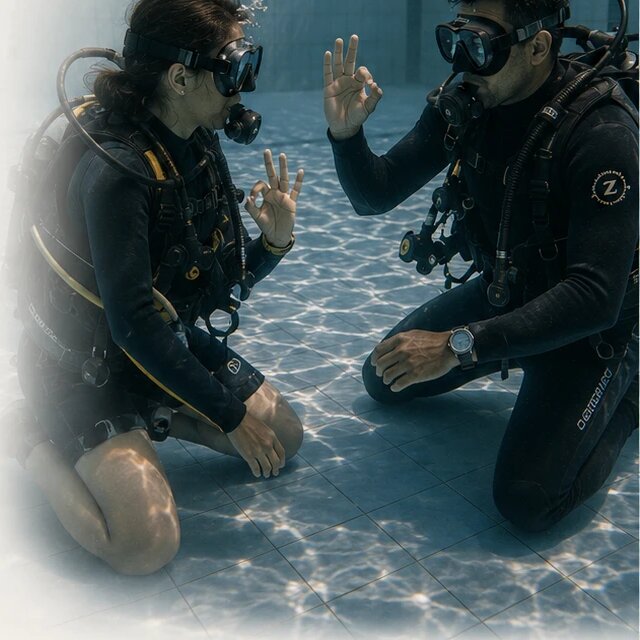
Scuba Diving for Children: What Families Should Know
By Zambian Outdoor Adventure Company · Updated · 7 min read
Children in Zambia can start scuba diving from age 6 with Try Scuba (K1,500) and from age 10 with Discover Scuba Diving (K2,200) or Pond Scuba, with the Zambian Outdoor Adventure Company. Children's sessions take place in a pool, need no swimming ability and start with a safety briefing. Every group is led by PADI-certified instructors and has no more than 4 children, so each young diver gets close attention.
Key takeaways
- Try Scuba from age 6; Discover Scuba Diving from 10
- Pool sessions with a safety briefing first
- No more than 4 children per group
- A good fit if your child is comfortable in water and keen to try
What age can children start scuba diving in Zambia?
Children in Zambia can start scuba diving at age 6 with the Zambian Outdoor Adventure Company. Children aged 6 to 9 can join Try Scuba, a guided first taste of breathing underwater that costs K1,500 per person and lasts 3–4 hours. From age 10, children can also join Discover Scuba Diving for K2,200, which adds basic scuba skills and a digital certificate of participation.
Children aged 10 and over can also join Pond Scuba, a full day of supervised scuba for K2,500 per person. Swimming ability is not required for any of the three experiences. For example, a family with children aged 7 and 11 could book Try Scuba for the younger child and Discover Scuba Diving for the older child, both led by PADI-certified instructors in Lusaka. In practice, age is the first filter, and readiness is the second.
| Age | Options | Price |
|---|---|---|
| 6–9 | Try Scuba | K1,500 |
| 10+ | Try Scuba, Discover Scuba Diving, Pond Scuba | K1,500 – K2,500 |
Is scuba diving safe for children?
Scuba diving for children with the Zambian Outdoor Adventure Company is built around a controlled setting and close supervision. Children's sessions take place in a pool rather than open water, and every session starts with a safety briefing on dry land covering the equipment, hand signals and the rule to breathe continuously and never hold the breath.
Each group has a maximum of 4 children, led by PADI-certified instructors Hennie Smit and Jonathan Chiwenu, so every young diver stays within the instructor's reach. All equipment is provided, fitted and checked by the instructor before the dive. For example, a child who feels unsure can stay in shallow water longer while the instructor gives individual attention. Parents should tell the instructor about any medical condition or ear problem before the session, because some conditions need a doctor's approval before diving. In practice, small groups and a pool setting make a child's first dive calm and unhurried.
How do you know if your child is ready for scuba diving?
A child's readiness for scuba diving depends more on comfort and attitude than on swimming ability. Swimming is not required for children's sessions, but three signs suggest a child is ready. First, the child is comfortable putting the face in the water. Second, the child can listen to an adult and follow simple instructions.
Third, and most important, the child wants to try scuba diving, rather than being persuaded by a parent or sibling. A child who meets all three signs usually enjoys a first session. For example, a 6-year-old who happily swims with goggles and asks to try diving is a good candidate for Try Scuba with the Zambian Outdoor Adventure Company. Children who are hesitant can watch first and join later. In practice, letting the child set the pace matters more than age alone, and instructors never push a young diver further than feels comfortable.
How do ears and cold affect children who scuba dive?
Ears and cold are the two most common comfort issues for children who scuba dive. Children's ears can be sensitive to water pressure, so young divers learn to equalise gently and early by pinching the nose through the mask and blowing softly, or by swallowing. Children should never force equalisation, and a child with a cold or blocked nose should not dive, because congestion stops the ears from equalising.
Children also tend to feel cold sooner than adults, especially after time in the water. Parents can help by bringing a towel and something warm to wear after the session. For example, a warm top and a snack after diving help a child recover comfortably. If a child's ears hurt during the session, the child signals the instructor, rises slightly and tries again. In practice, early equalising and a warm towel solve most comfort problems for young divers.
What can parents do to help a child's first dive?
Parents can make a child's first scuba dive easier in four ways. First, tell the instructor about any medical condition or ear problem when booking, so the Zambian Outdoor Adventure Company can advise before the session. Second, pack swimwear, a towel, something warm and a snack.
Third, talk through the session beforehand, from the safety briefing to the first breath underwater, so there are no surprises. Fourth, let the child go at their own pace and avoid pushing a nervous child. For example, a parent might read the article on what to expect on a first dive with the child the evening before. On the day, the instructor leads the session while parents can watch from the poolside. In practice, children who know what will happen and feel no pressure enjoy their first dive the most.
Can you book scuba diving for a birthday, family or school?
Scuba sessions for birthdays, families and schools are popular with the Zambian Outdoor Adventure Company. Birthday parties often run at a family's own pool, because the PADI-certified instructors bring all the scuba equipment to the home. Each group has a maximum of 4 divers, so larger parties are split into several groups during the session.
Schools can book group sessions for pupils from age 6, with a quote on request. Families can book Try Scuba and Discover Scuba Diving together, so children and parents dive on the same day. For example, a birthday with 8 children aged 7 to 11 could run as two groups of four at the family pool. Send the number of children, their ages and the preferred date, and the team replies within 2 hours.
Scuba birthday parties →School programmes →Try Scuba in Zambia →