
What to Expect on Your First Scuba Dive
By Zambian Outdoor Adventure Company · Updated · 7 min read
A first scuba dive is a supervised session where a beginner gets a safety briefing, is fitted with scuba equipment and practises breathing underwater in shallow water with an instructor beside them. Breathing from a regulator can feel strange at first and usually settles once the diver relaxes and breathes slowly. With the Zambian Outdoor Adventure Company, first dives take place in Lusaka pools, last 3–4 hours, need no swimming ability and run in groups of no more than 4 people, led by PADI-certified instructors.
Key takeaways
- The dive starts on dry land with a safety briefing
- First breaths happen in shallow water, at the diver's own pace
- Breathe slowly and continuously; never hold your breath
- Equalise your ears early and often while descending
How should you prepare for your first scuba dive?
Preparing for a first scuba dive is simple. First, bring swimwear and a towel, because the Zambian Outdoor Adventure Company provides all scuba equipment. Second, eat a light meal and drink water before the session, since diving on an empty stomach or after a heavy meal is uncomfortable. Third, avoid alcohol before diving.
Additionally, nobody should dive with a cold, flu or blocked nose, because congestion makes equalising the ears difficult and painful. Finally, tell the instructor about any medical condition before the session starts. Some conditions need a doctor's approval before diving, and an instructor would rather know in advance than discover a problem in the water. In practice, a first-time diver who arrives rested, hydrated and healthy has the easiest and most enjoyable first dive. Arriving a few minutes early also leaves time for questions before the briefing begins.
What happens in the scuba safety briefing?
The safety briefing is the first part of every scuba session with the Zambian Outdoor Adventure Company and takes place on dry land before anyone enters the water. During the briefing, a PADI-certified instructor explains how each piece of scuba equipment works and teaches the few rules beginners need most.
The first rule is to breathe slowly and continuously and never hold your breath underwater. The second rule is to equalise the ears early and often while going down. The third rule is to stay close to the instructor at all times. The instructor also teaches four essential hand signals: OK, something is wrong, go up and go down. For example, a diver who feels ear pressure signals the instructor, rises slightly and tries again. The briefing is also the right moment to ask questions, so first-time divers should speak up about anything unclear before kitting up.
What scuba equipment does a beginner use?
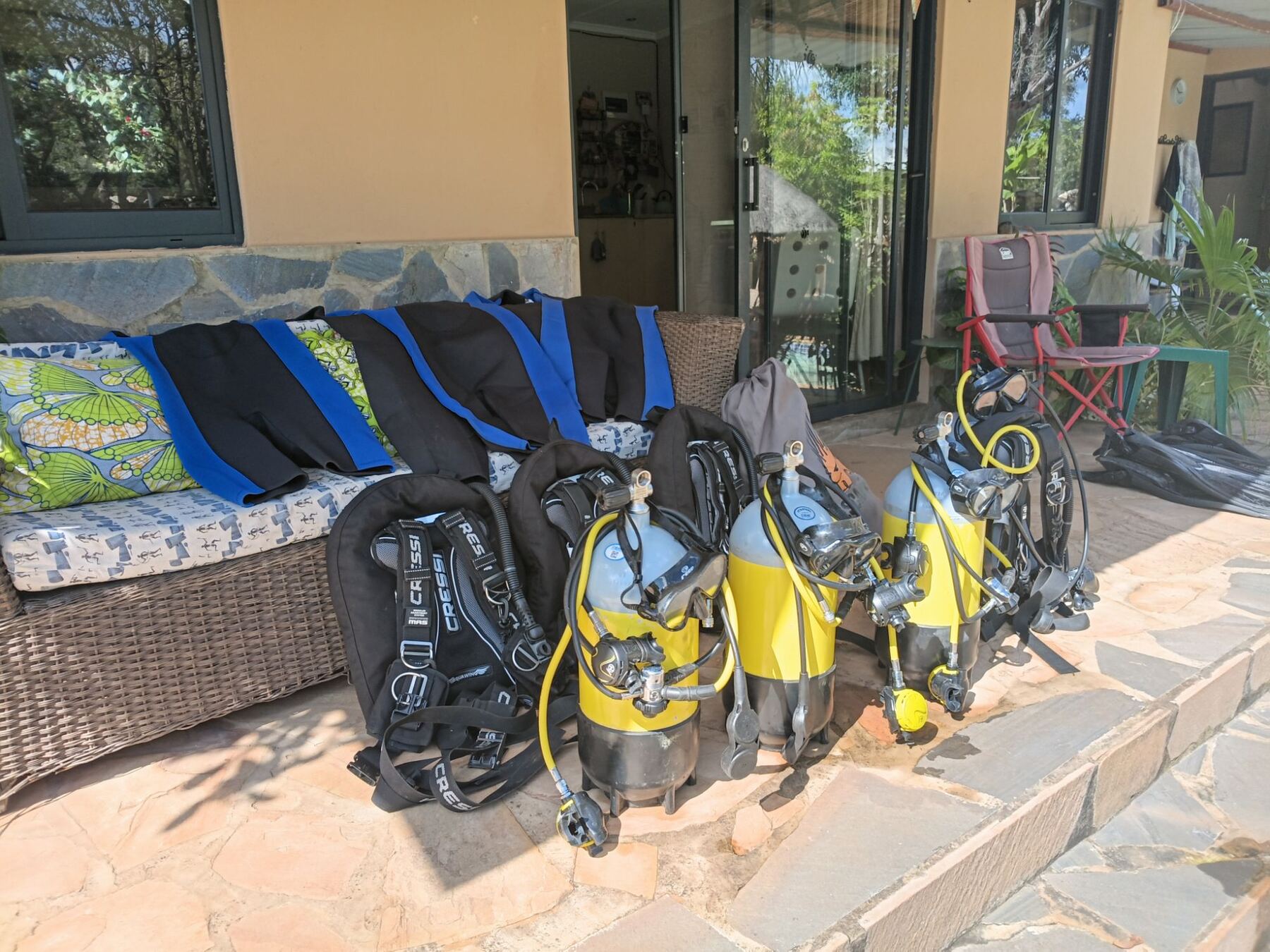
A beginner on a first scuba dive uses six main pieces of equipment, all provided by the Zambian Outdoor Adventure Company. The mask keeps an air space in front of the eyes so the diver can see clearly. The regulator is the mouthpiece a diver breathes from, delivering air from the cylinder. The cylinder is the tank that holds the air supply. The buoyancy control device, or BCD, is an inflatable jacket that holds the cylinder and helps the diver float or sink. Fins help a diver move through the water with little effort. Weights offset natural buoyancy so the diver can stay underwater.
The instructor fits each item before the dive, checks the equipment works and shows the diver how to use the regulator and BCD. First-time divers do not need to buy or rent anything.
| Item | What it does |
|---|---|
| Mask | Keeps an air space in front of the eyes for clear vision |
| Regulator | The mouthpiece that delivers air from the cylinder |
| Cylinder | The tank that holds the air supply |
| BCD (jacket) | Inflatable jacket that holds the cylinder and controls floating |
| Fins | Help the diver move with little effort |
| Weights | Offset natural buoyancy so the diver stays underwater |
What does breathing underwater feel like?
Breathing underwater for the first time feels unusual but quickly becomes natural. On a first scuba dive, beginners start in water shallow enough to stand in. With the regulator in the mouth, the diver puts the face under the surface and takes slow, deep breaths in and out through the mouth.
Common first impressions include the sound of bubbles with every breath out, the gentle pressure of the mask on the face and the slight resistance of the regulator. Each sensation is normal. The most important habit is breathing slowly and continuously, without holding the breath. For example, many beginners find counting a slow rhythm helps them relax. Once the diver is comfortable, the instructor guides the group a little further into the pool. With the Zambian Outdoor Adventure Company, groups of no more than 4 people mean the instructor can match the pace to each diver.
How do you equalise your ears when diving?
Equalising the ears means balancing the air pressure inside the ears with the water pressure outside. Water pressure increases with depth and pushes on the eardrums, so a diver needs to equalise early and often while descending. The most common technique is to pinch the nose through the soft part of the mask and gently blow against the closed nose. Swallowing or moving the jaw also helps some divers.
The key is to equalise before any discomfort starts, roughly every arm's length of descent. If the ears hurt, the diver should stop, signal the instructor, rise a little and try again. A diver should never force equalisation by blowing hard. Divers with a cold or blocked nose should not dive, because congestion stops the ears from equalising properly. In practice, ear pressure is the most common issue on a first scuba dive, and equalising early solves most problems.
Which scuba skills do beginners practise?
On a Discover Scuba Diving session with the Zambian Outdoor Adventure Company, beginners get an introduction to basic scuba skills under the direct supervision of a PADI-certified instructor. The skills often include clearing a little water out of the mask by breathing out through the nose, finding and replacing the regulator if it comes out of the mouth, and controlling floating and movement in the water.
The skills are introduced slowly, in shallow water, and each one is demonstrated by the instructor first. Try Scuba, which is open from age 6 and costs K1,500, focuses on the experience of breathing underwater rather than skills. After a first dive, beginners in Zambia can book a full day of Pond Scuba, join dives at Chisamba, Mulungushi Dam, Tiffany's Canyon and Lake Tanganyika, or join the waitlist for the Open Water Diver course at Lake Tanganyika. For example, a diver who enjoyed the pool can use Pond Scuba to build confidence before the lake.